
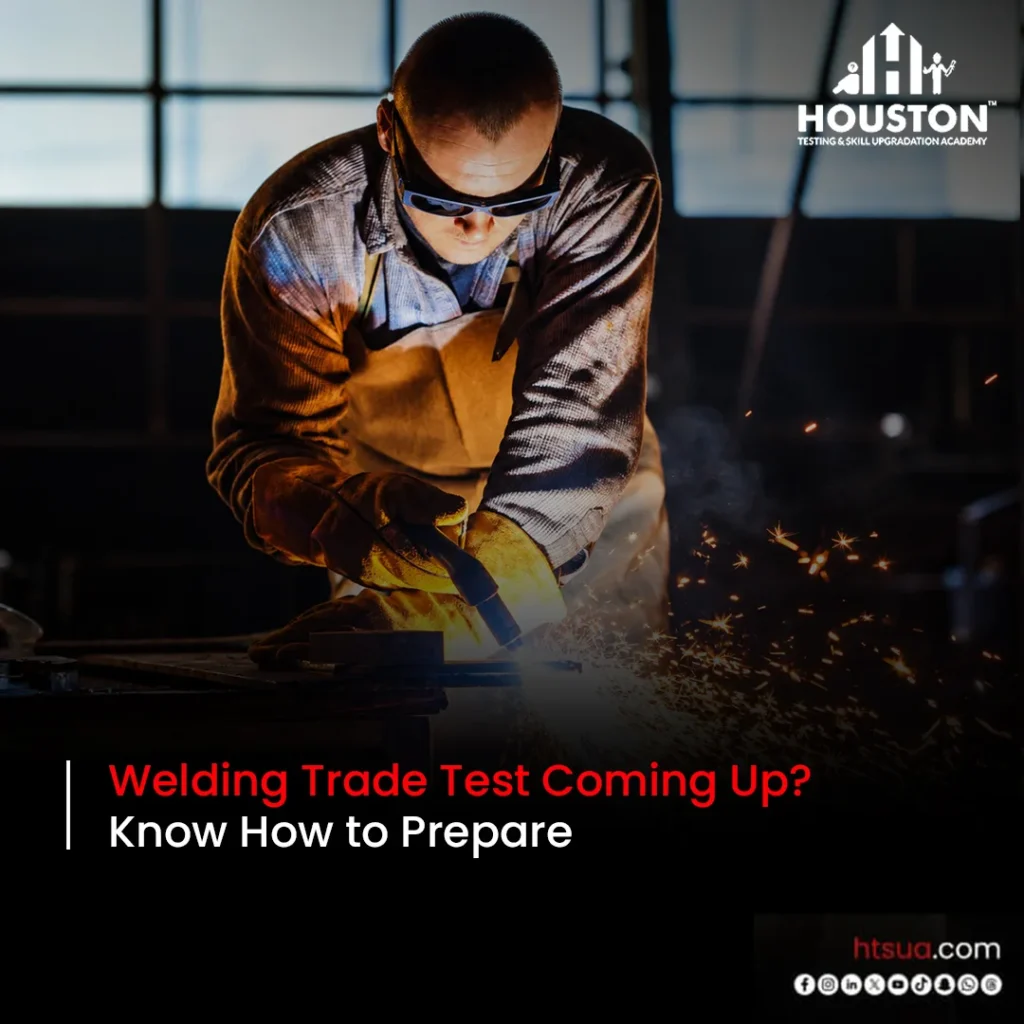
Welding Trade Test Coming Up? Know How to Prepare
Are you looking for a lucrative employer that can pay you what you expect for your welding skills? This detailed article ends your search. Let us explain how.
You may have heard of the welding trade test, which assesses your welding skills and verifies your ability to deliver the expected performance. If you pass it through a reputed institution, this test can open international doors for you.
But wait!
It’s not that easy, as it requires certain criteria to be fulfilled before you get the passing and validation certificate for your welding skills.
So, without delay, let’s explore what you can expect when you prepare for the welding trade test.
Prepare for your welding trade test with structured training and practical guidance.
A] What to Expect in a Welding Trade Test
1. Practical Welding Test
Firstly, you may be asked to undergo a practical welding test. It may include your hands-on welding skills across different materials, adherence to welding procedure specifications (WPS), and workflow discipline. However, the test procedure depends heavily on the employer, your qualifications, and the applicable welding procedure. So, research thoroughly on the employer, sharpen your skills, and keep your certificates handy.
2. Welding Position Assessment
The welding position assessment assesses your ability to handle joint orientations like flat, vertical, horizontal, and overhead. Based on how you perform, employers qualify you and select you for their various welding jobs. So, practise every welding position you are good at or relevant to your target trade before heading for the test.
3. Material and Welding Process
You are expected to be familiar with various material properties and how they should be welded. You may be asked to perform various welding processes on different materials and/or different thicknesses. So, before appearing for the welding trade test, rehearse the welding processes and equipment-use techniques for an increased selection percentage.
4. Weld Quality Inspection
Weld quality inspection checks the weld’s consistency and quality. The inspection may include appearance, dimensions, penetration, defects, and conformity with specified requirements. So, while completing the test, ensure you maintain the quality and appearance of the welds.
5. Safety and Work Practices
Safety and work practices are a must-have skill you should be proficient in, as failing in any safety practice costs money, time, and lives. So, be ready for a strict evaluation of PPE compliance, electrical checks, materials prep, and execution discipline during a welding trade test.
B] Why Is It Necessary to Pass a Welding Trade Test?
1. Demonstrates Practical Welding Ability
A certificate or a well-written resume alone may not demonstrate hands-on competence. Employers need proof that you can actually strike an arc and produce a sound weld, not just claim you can. A trade test provides an opportunity to demonstrate your actual welding skills under observed conditions. So, treat the test as your chance to prove on the plate what your paperwork says on paper.
2. Builds Employer Confidence
Employers can assess whether a candidate can produce welds according to specified requirements only by watching them weld. Passing the test reassures the employer that you will perform reliably on the job, not just in a controlled setting. So, a clean pass builds the kind of confidence that gets you hired over an equally qualified candidate who couldn’t prove it.
3. Supports Career Opportunities
Passing a required trade test may be an important step for certain welding roles, especially in industries with strict codes and standards. So, without it, you may be filtered out before you even get considered for the job.
4. Highlights Professional Preparedness
The test shows that the candidate can work safely, accurately and consistently, not just skilfully, on a good day. So, use it to display discipline as much as skill.
5. Particularly Relevant for Overseas Job Applications
Some employers or projects may require trade testing before hiring or deployment, particularly for international contracts. So, if you’re eyeing an overseas welding job, expect the trade test to be a non-negotiable gatekeeper.
C] How to Pass a Welding Trade Test: Step-by-Step Preparation
1. Understand the Test Requirements
First, research the employer and job role you are applying for; don’t prepare based on assumptions. Thorough research briefs you on the practices you should focus on, not everything the welding process covers. However, most welding trade tests try to assess how much you know about the welding process, material, joint type, welding position, dimensions and acceptance criteria. And, based on that, they grade you.
2. Practise the Exact Welding Technique
As we discussed in the above point, research provides you with a summary of what to prepare. Mastering the specific technique for the particular test prevents burn-through, lack of fusion, and thus disqualification. So, even if you know every procedure, be as specific as you can. Also, focus on consistency rather than quantity, and read the Welding Procedure Specification (WPS) for a higher chance of qualification.
3. Improve Control of Welding Parameters
One of the skills that you should focus on to pass the weld trade test is controlling welding parameters. Also, learn to recognise how parameter changes affect the final weld. It may include current, voltage, travel speed, and other relevant settings that affect weld quality.
4. Practise Different Welding Positions
Welding as a whole combines an array of positions, including flat, horizontal, vertical, overhead, etc. Practising every possible position that has the possibility of being asked by the examiner builds your confidence and increases your percentage of being hired.
5. Prepare Your Equipment
Before heading to the welding trade test centre, thoroughly prepare your equipment. It may include checking your machine settings, leads, electrode, wire condition, torch, ground connection and other required equipment before starting.
6. Prepare the Workpiece Correctly
Employers especially pay attention to how you prepare your workpiece. Poor workpiece preparation can severely affect weld quality even when welding technique is good. So, ensure you do proper cleaning, joint preparation, alignment and fit-up for better selection chances.
7. Follow Safety Procedures
Safety procedures are one of the key areas employers pay attention to. So, show you know safety procedures by wearing appropriate PPE and maintaining safe handling throughout the test. Doing so will highly elevate your selection chances.
8. Inspect Your Weld
At last, inspect your weld thoroughly to check the quality of your work. To ensure you are accustomed to inspection, you can develop the habit of checking the finished weld for visible defects and dimensional or profile issues.
D] Prepare for Welding Trade Tests with HTSUA
HTSUA is a leading trade test certificate provider with thousands of success stories. We pay utmost attention to bringing your welding skills up to global standards and preparing you for job success through your skill verification. We develop practical welding skills in you and prepare you for trade assessment.
We Position the Training at the Forefront:
- Practical welding skill development
- Understanding welding techniques and procedures
- Hands-on practice
- Weld quality awareness
- Safe working practices
- Preparation for industry-oriented assessments
We boast structured training, which helps candidates identify and correct technique gaps before attempting a trade test.
Why Choose Structured Training?
- Guided practical learning
- Instructor feedback
- Repeated practice
- Better familiarity with welding equipment
- Increased confidence before assessment
Build your welding skills and get ready for industry-orientated trade testing with HTSUA.
Conclusion: Your Weld Is Only as Valuable as the Proof Behind It
Welding trade testing requires lots of practice to pass and get the certification. Follow the steps suggested above and get your dream welding job with a high salary. However, with the right guidance, getting certified and becoming job-ready can be a lot easier.
HTSUA is a certified skill testing and certification institution with decades of trust from our thousands of candidates. We work along with them to make them welding trade test certified and job-ready. Contact us now!
Categories
Latest Post
September 3, 2026