The Trade Test: What Stands Between Your Skills and an Overseas Job Offer
You’ve cleared the interview. Your CV checks every box, your references are solid, and the recruiter sounded genuinely interested. Then one line shows up in the process that catches most candidates off guard: a trade test is required before final selection.
For skilled workers going after overseas jobs, that single line decides more than any interview does. A trade test for international job recruitment isn’t a formality tacked onto the end of hiring; it’s the actual gate between an offer letter and a polite rejection email.
In this blog, let’s look at what a trade test in overseas recruitment actually involves, how employers use it, and how to prepare for one properly instead of walking in and hoping your years of experience carry you through.
Don't let an unprepared test day cost you the job. Prepare with HTSUA.
A] Why Trade Tests Have Become Standard in Overseas Hiring
A decade ago, a strong reference and a documented work history could get a skilled worker through most overseas hiring processes. That’s no longer enough on its own.
Employers hiring across borders can’t verify a candidate’s claims the way a local employer can. They can’t call a supervisor from three countries away and get an honest answer in five minutes. So instead of relying on paperwork alone, recruiters and contractors now build in a direct, practical checkpoint: a skilled worker trade test for overseas jobs that puts the candidate’s actual ability on display, not their résumé’s version of it.
This is exactly what a trade test in overseas recruitment is at its core: a structured, hands-on assessment where a candidate performs real trade tasks under observation and gets evaluated against a fixed benchmark rather than a subjective impression. Pass it, and an employer has proof, not just a promise. Fail it, and no amount of prior experience on paper changes the outcome.
For many candidates, this comes as a surprise, since domestic hiring rarely demands the same level of direct verification, which is exactly why so many experienced tradespeople get caught off guard the first time they apply overseas.
B] What Is A Trade Test In Overseas Recruitment?
Trade tests for international job recruitment vary by trade and by country, but most follow a similar shape underneath the surface.
1. Practical Task Assessment
This is the core of almost every trade test. Candidates carry out real tasks such as wiring a panel, running a weld, and assembling a fitting under timed and observed conditions. Assessors are watching technique, safety practice, and accuracy, not just whether the end result looks right.
2. Safety and Procedural Knowledge
Most tests include a component that checks whether a candidate follows the correct safety protocol, not as an afterthought but as a pass/fail element in its own right. A technically sound piece of work carried out unsafely can still fail the assessment.
3. Specialisation-Specific Requirements
A cable jointer and a generator technician are not tested in the same way, even within the same broader trade. Employers targeting a specific role usually specify the exact specialisation the test needs to cover, which is why knowing your target role before booking a test matters more than most candidates realise.
C] How to Prepare for an Overseas Trade Test
Preparation starts well before test day, and most of the actual failure points are avoidable with the right run-up.
1. Confirm the Exact Test Standard
Trade tests aren’t standardised globally. A test aligned with Gulf hiring frameworks looks different from one built for a different market. Confirm which standard your target employer actually recognises before you prepare for the wrong one.
2. Refresh Technique Under Time Pressure
Field experience builds competence, but most candidates haven’t performed familiar tasks under a strict clock and an assessor’s eye in years. Practising under those exact conditions, not just the task itself, closes a surprising amount of the gap.
3. Review Safety Protocol Explicitly
Since safety is often graded separately from the technical task, treat it as its own preparation item rather than assuming years of habit will carry over automatically under test conditions.
4. Get Familiar With the Tools on Site
Assessment centres often use specific equipment and materials that may differ slightly from what a candidate is used to on a home site. A short familiarisation session beforehand removes one more variable on the day itself.
Most industrial trade tests run somewhere between three and six hours, depending on the specialisation, and candidates who’ve prepared specifically for the format consistently perform better than those relying on raw experience alone. It’s a narrow window to prove years of skill, which is exactly why format familiarity matters as much as technical ability on the day itself.
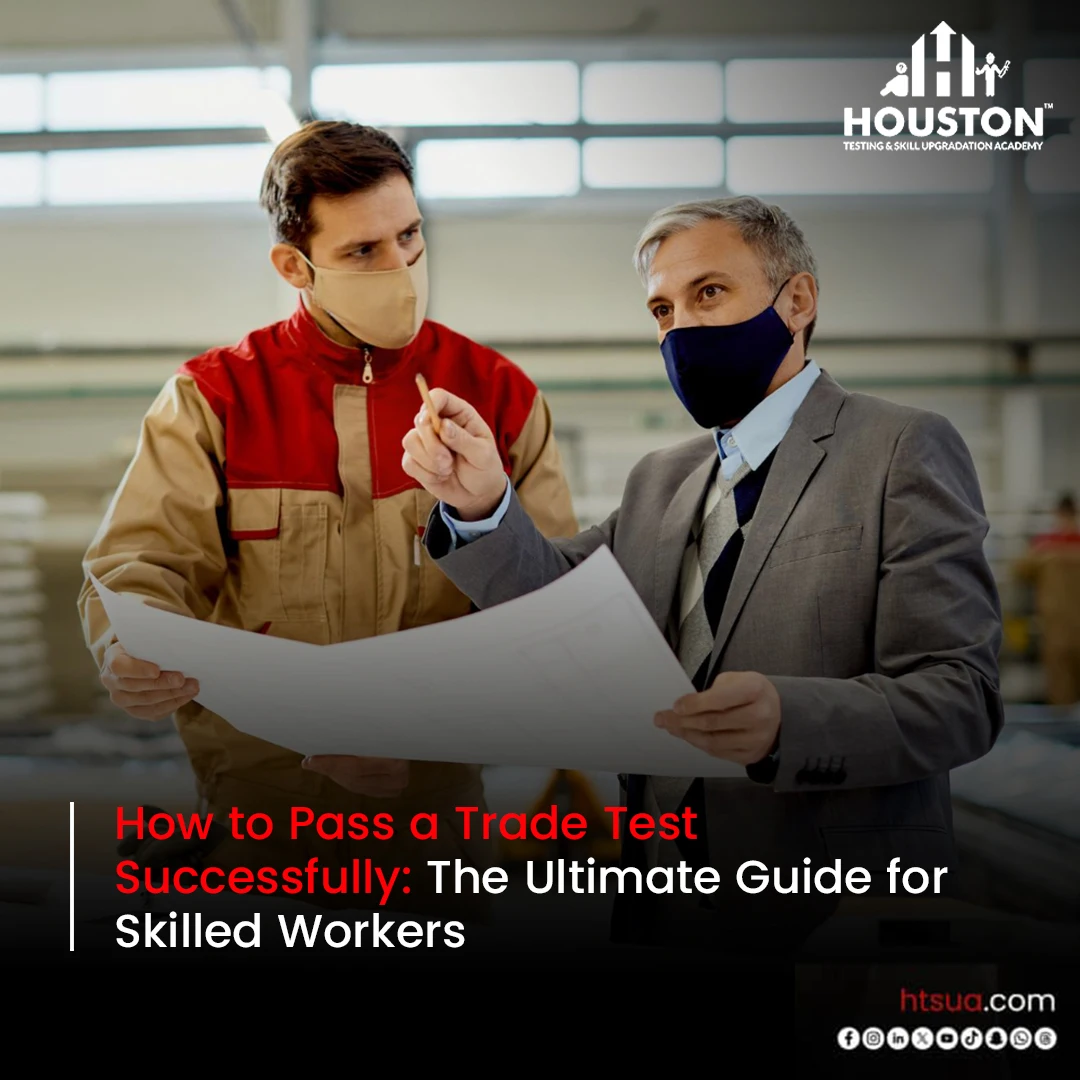
Also Read: How to Pass a Trade Test Successfully: The Ultimate Guide for Skilled Workers
D] What to Look For Before You Book a Trade Test
Not every testing centre carries equal weight with overseas employers, and the difference often only becomes obvious after a candidate has already paid for and sat a test that leads nowhere.
Before committing, it’s worth asking:
- Is this testing centre’s certification actually recognised by the employers or countries you’re targeting?
- Is the assessment biometric-verified, or can results be disputed later?
- Does the centre have documented placement outcomes with real overseas employers?
- Will you receive guidance on what the specific test involves before you sit it, or are you walking in blind?
A trade test result only carries value if the employer on the other end trusts where it came from. Skipping this check is how candidates end up with a certificate that opens no doors at all, and by then, the time and cost already spent are difficult to recover.
E] How HTSUA Prepares You for the Trade Test
At HTSUA, we treat the trade test as the single highest-leverage moment in a candidate’s overseas job search, because it is. Our preparation programmes are built around the actual standards used by Gulf and international employers, including Takamol and NSDC-aligned frameworks, so candidates walk in already familiar with the format, the equipment, and the pace of a real assessment.
Our trainers work across specialisations, from house wiring and industrial electrical work to fire alarm systems, cable jointing, and generator servicing, so preparation is built around the specific test a candidate is actually going to face. Candidates who go through structured preparation before sitting a trade test consistently walk in calmer and perform closer to their actual ability, rather than losing marks to nerves or an unfamiliar format on the day itself.
Turn your skills into a certified, employer-trusted credential.
Conclusion: Your Skills Deserve to Be on Record
The demand for skilled tradespeople overseas keeps climbing, driven by infrastructure growth, renewable energy projects, and urban expansion across the Gulf and beyond. But that demand rewards proof, not potential. A trade test is where years of hands-on skill either translate into a verified credential or quietly go unrecognised.
If you’ve built the skill, don’t let an unprepared test day be the reason it doesn’t show. Get in touch with our team of expert trainers to find the right preparation path for the overseas trade test certificate standing between you and your next role.
Categories
Latest Post

July 9, 2026