
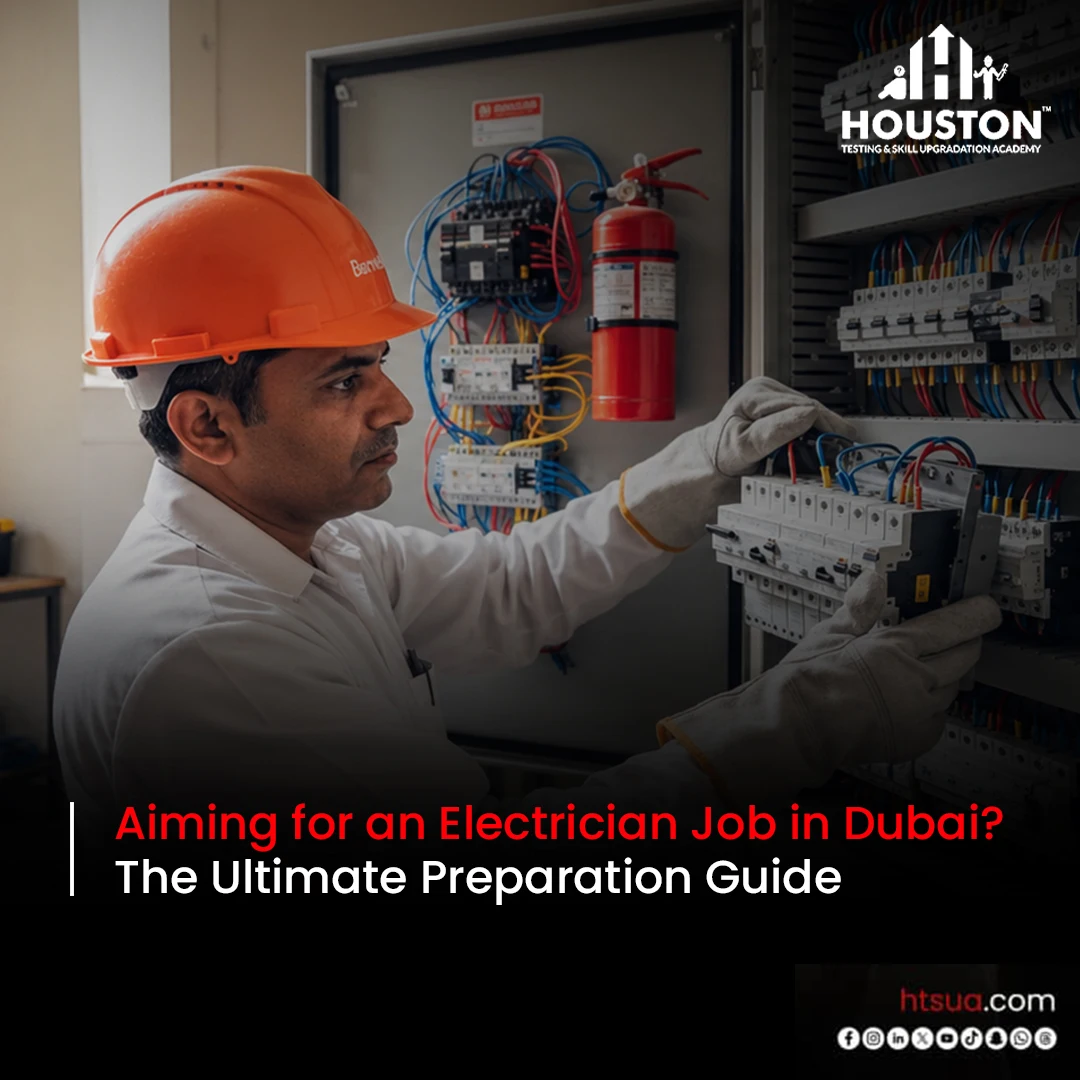
A Practical Guide on How to Prepare for an Electrical Trade Test

Your electrical trade test date is set, and the job you want depends on it. Whether it’s a role in your home country or an overseas contract, one test now stands between your experience and the offer.
Knowing your trade is not the same as being ready for the test. Candidates who wire confidently on site still lose marks to rushed drawings, missed safety steps, and untested circuits.
So, let’s look at what the test will actually ask of you and how to prepare, step by step.
Build the confidence and practical skills you need to clear your trade test and move ahead in your electrical career.
A] What is an Electrical Trade Test?
An electrical trade test is a skills assessment that places an electrician at a recognised competence level, or grade, under the National Skills Qualifications Network. It checks your practical ability, technical knowledge, and safe working practices against the standard for that grade.
Employers use the result to decide your role, responsibilities, and sometimes your pay. So, you should find out which grade your target employer requires before you start preparing.
B] What to Expect in an Electrical Grade Test
1. Practical Installation and Wiring Test
You may be asked to wire a circuit or distribution board from a given diagram. It can include conduit and cable work, switches, sockets, lighting, and neat terminations. The format depends on the employer, your qualification, and the applicable standard. It’s important that you research the employer, sharpen your skills, and keep your certificates handy.
2. Theory and Calculations
Many tests go beyond basic wiring and cover starters and control circuits, such as forward and reverse, star-delta, and sequence starting. This is where unprepared candidates often get stuck. Revise and keep practising until you can do this without second-guessing.
3. Drawings and Schematics
You are expected to read wiring diagrams, single-line diagrams and symbols accurately. A misread drawing leads to a wrong installation, however neat the work looks.
4. Testing and Fault Finding
You may be asked to test an installation or trace a deliberate fault using a multimeter, megger or test lamp. This includes continuity, polarity, insulation resistance and earthing checks. So, learn what each reading means, not just how to take it.
5. Safety and Work Practices
Safety is a must-have skill and the most important aspect of the electrician trade test syllabus, because a failure in any safety practice costs money, time, and lives. Be prepared for strict evaluation of PPE, isolation, earthing, and overall execution discipline.
C] Why is it Necessary to Pass the Electrical Grade Test?
1. Demonstrated Practical Ability
A certificate or resume alone may not prove hands-on competence. A trade test certification lets you show your skills under observation. So, treat it as your chance to prove on the board what your paperwork says.
2. Builds Employer Confidence
Employers can judge your work to specification only by assessing how well you do it. A clean pass reassures them you will perform reliably on site. So, it can put you ahead of an equally qualified candidate who couldn’t prove it.
3. Supports Career Growth
Passing a recognised test can open the way from wireman to senior roles and supervisory positions.
4. Highlights Professional Preparedness
The test shows you can work safely, accurately, and consistently, not just skilfully on a good day. Use it to display discipline as much as skill.
5. Especially Relevant for Overseas Job Applications
Many overseas employers and projects, especially in the Gulf, ask for trade test results before hiring or deployment, even if you already hold an ITI or NCVT certificate. So, if you’re eyeing a job abroad, expect the trade test to be a non-negotiable gatekeeper.
D] A Step-by-Step Preparation Guide on How to Pass the Electrician Trade Test
1. Understanding the Test Requirements
First, research the employer and job role instead of preparing on assumptions. Check the level and documents they expect, and confirm the pass mark for the practical section. Most tests assess installation, drawings, testing, and safety, and grade you on each.
2. Revise Theory and Calculations
Go through Ohm’s law, power, cable sizing, and voltage drop. Work through sample questions under time limits.
3. Practice Wiring to a Drawing
Build complete circuits from a drawing, from cable routing to final termination. Focus on consistency and neat workmanship rather than quantity. This ensures your installation looks as professional as it performs.
4. Practice Motor and Control Circuits
Rehearse starters, forward and reverse circuits, and sequence control until the wiring logic is second nature. Examiners notice hesitation as quickly as errors.
5. Master Your Testing Instruments
Learn to use a multimeter and insulation tester correctly and to interpret the readings. Knowing what a result means matters as much as taking it.
6. Practice Fault Finding
Trace common faults, such as open circuits, loose connections, and incorrect wiring, using a step-by-step method. Examiners value a logical approach over random guessing.
7. Prepare Your Tools and Follow Safety Procedures
Before test day, check your tools, instruments, and PPE, and carry a scientific calculator. During the test, isolate before working and handle everything safely. Doing so will raise your selection chances considerably.
8. Check Your Work Before You Finish
At last, inspect and test your installation. Check terminations, labelling, tidiness, and readings before declaring the task complete. You can catch small errors before the examiner does.
E] Prepare to Ace Your Electrical Grade Test with HTSUA
Preparing alone can leave gaps you only discover on test day, such as an unfamiliar control panel, a drawing in a different symbol style, or a safety step you skipped out of habit. At Houston Testing & Skill Upgradation Academy (HTSUA), we align your practical skills with what international employers expect from electricians.
Rather than testing you blindly, our trainers give you targeted pre-assessment refreshers and intensive hands-on practice, so you know what to expect before the assessor arrives. Our electrician training focuses on:
- Wiring from drawings to recognised installation practice
- Industrial control panels and motor starter circuits
- Inspection, testing and wiring diagnostics
- Maintenance circuits and fault finding
- Safe isolation, lock-out/tag-out and PPE discipline
- Time management and workspace habits that assessors score
Expand your electrician career globally with the right training and guidance to back you.
Conclusion: Your Skills Need Proof to be of Value in a Competitive Market
Passing comes down to how well you do the electrical trade test preparation. When you know the drawing, follow safe isolation every time, and test your work before the assessor does, the exam stops being a source of anxiety and becomes a chance to show what you can do.
At HTSUA, we help electricians turn real experience into verified, internationally recognised skills. Contact us today to take charge of your career and unlock the overseas opportunity you deserve.
Categories
Latest Post

October 5, 2026


September 3, 2026