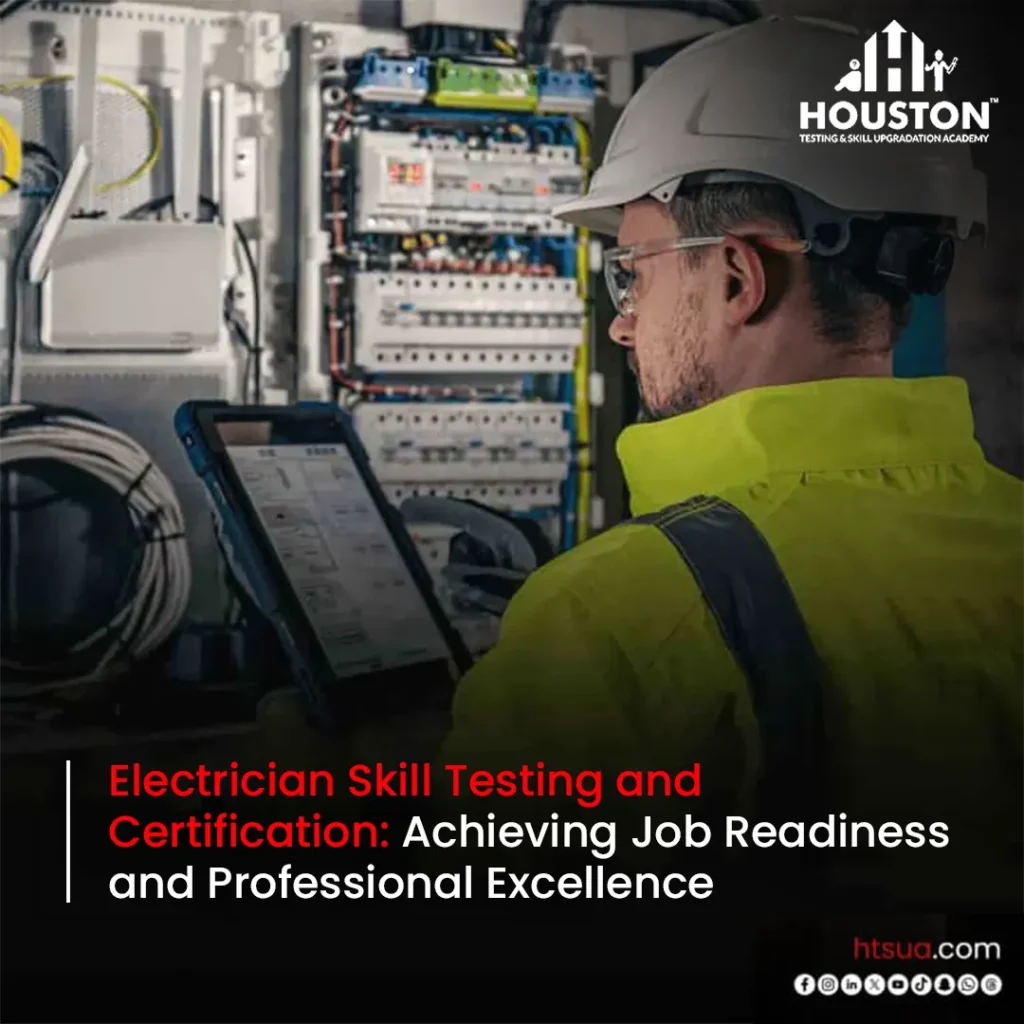
Electrician Skill Testing and Certification: Achieving Job Readiness and Professional Excellence
Everybody hopes to have a secure, high-paying career so that they can enjoy a comfortable life and provide for their families. The reality though, is that a significant number of technicians in the industry are not achieving the professional success they had hoped for.
Can you guess the biggest reason why such a large proportion of electricians are dissatisfied with their career progression?
Lack of validated skills.
Simply put, a number of workers in the trade are relying solely on their years of service and are taking no steps whatsoever to certify their expertise. They are then in for a rude shock when they realise that experience alone is no longer sufficient to meet the demands of modern, technical projects.
Easily benefit from our state-of-the-art trade testing and certification programs.
How Skill Certification Protects Your Career Growth
In today’s market, employers are under greater pressure to deliver without error, and they want verified proof of your capability before they deploy you to a site.
What options are you left with when you find yourself in such a precarious professional situation? The following spring to mind immediately:
- Delaying your career progression.
- Accepting lower-level roles despite your years in the field.
- Lowering your expectations about the kind of high-value industrial projects you wish to lead.
Do not let a lack of certification hold your professional lifestyle to ransom!
Structured testing does not replace your experience; it validates it. It is advisable to start preparing for a professional skill testing scheme now to ensure your habits meet defined industry benchmarks.
A] The Benefits of Electrician Skill Testing
A skill test is basically a long-term professional plan you initiate for yourself to achieve job readiness. Many professionals still ask, “What is electrician skill testing in practical terms?” At its core, it is a structured evaluation often conducted at a specialised SVP test centre in India. It’s designed to measure whether you can perform tasks safely, accurately, and independently.
How Can Skill Testing Help You Maximise Your Career Potential?
To ensure safer infrastructure, employers are now legally and practically prioritising workers who have undergone a workplace readiness assessment.
If you say no to professional skill testing, especially one that leads to a recognised certification, it would be akin to refusing an offer of a pay rise. In high-value industrial or international environments, even minor errors can lead to serious hazards. So, unless you are content with remaining in stagnant roles, it would be unwise to opt out of formal trade testing.
B] How Do I Prepare for Electrician Skill Testing?
Managing your career path is not only complicated but also intensely time-consuming. A common question we hear is, “How do I prepare for electrician skill testing?” Preparation is the difference between a “Pass” and a “Fail”. In most professional assessments, the standards are high because there is zero margin for error in electrical work.
1. Master the Fundamentals
You must be comfortable with electrical principles. You should also possess 100% clarity on voltage, current flow, and circuit protection. While you are allowed to rely on your experience, there are limits to what “on-the-job” learning can teach you regarding the interpretation of technical drawings and schematics.
2. Perfect the Practical
Hands-on proficiency is weighted heavily. Practise these specific tasks:
- Wiring Installations: Ensure every task is performed methodically rather than instinctively.
- Fault Diagnosis: Master the ability to identify issues under timed conditions to simulate real assessment pressure.
3. The “Safety First” Mindset
Failure to comply with safety protocols, such as proper isolation techniques, can lead to severe consequences. Just like legal violations, ignoring safety during a test, even if the technical work is perfect, can lead to immediate disqualification.
C] Is Electrician Skill Testing Worth It?
If you are confused about whether or not you should stay as you are or seek certification, don’t be. Remember that for most people, skill testing is a great idea, especially if you aim to work on large infrastructure projects or international assignments.
1. Financial Appreciation and Stability
Industry data shows a marked change in earnings and stability once a worker is certified:
- Unverified Electricians: Often limited to informal settings with unpredictable income.
- Certified Technicians: Entitled to higher-tier contracts because their certification reduces employer risk.
- Professional Excellence: Leads to repeat contracts and access to more complex, higher-paying assignments.
Professional Credibility
By offering your potential employer a verified skill card, you show your seriousness and commitment to professional standards. It demonstrates that you are prepared to make a long-term investment in your future. Possessing such accreditations shows that you are interested in moving from “accidental” growth to “structured” success.
D] The Responsibilities of the Employer
A job readiness assessment for electricians is not just for the worker; it is also a vital metric for the employer. Every firm is now looking to maximise adherence to safety legislation and project predictability.
1. Penalty for Non-Compliance
If a company fails to employ certified staff for critical industrial roles, they face the very real prospect of project delays or safety violations. The “regulators” of industry standards may observe:
- Compliance Gaps: Identifying weaknesses in the workforce that lead to costly errors.
- Supervision Intensity: Non-certified staff require more constant supervision, which drains company resources.
2. Managing Skill Continuity and Compliance
Managing a team of technicians is not only complicated but also intensely time-consuming. It is a legal and operational responsibility for every employer to ensure that their staff’s certifications are kept up to date.
You must assess your workforce regularly to identify whose credentials are about to expire, as deploying a technician with lapsed certification is a risk no professional firm should take. To avoid a rude shock during a safety audit, employers should implement a structured tracking system.
E] Achieving Professional Excellence with Houston
At Houston, we believe in making the entire trade testing and certification process as easy as possible for our clients. We will set up your assessment in a matter of minutes to ensure you are ready for deployment.
We will continually assist you with your professional requirements in the following ways:
- Automatically assessing your technical competence against real-world scenarios and site realities.
- Providing state-of-the-art facilities that reflect actual job conditions, ensuring your skills can withstand the pressure of live projects.
- Validating safety discipline so that your working habits align perfectly with modern industry benchmarks.
- Many other easy-to-use value-added services to help you strengthen your professional standing.
Take the next step toward verified capability and professional recognition.
Conclusion
Professional excellence in the electrical trade is not defined only by your years on the tools; it is defined by consistency, safety awareness, and accountability. As we have seen, the reality of the modern industry is that experience alone is no longer enough to secure the standard of career you desire. By pursuing structured testing and certification, you are essentially initiating a long-term plan to protect your professional future. Whether you are a worker looking to boost your salary or an employer needing to ensure a capable and compliant workforce, taking action today ensures you won’t face a precarious situation tomorrow.
Categories
Latest Post