
Welding Certification: How It Changes Your Career, and How to Get One
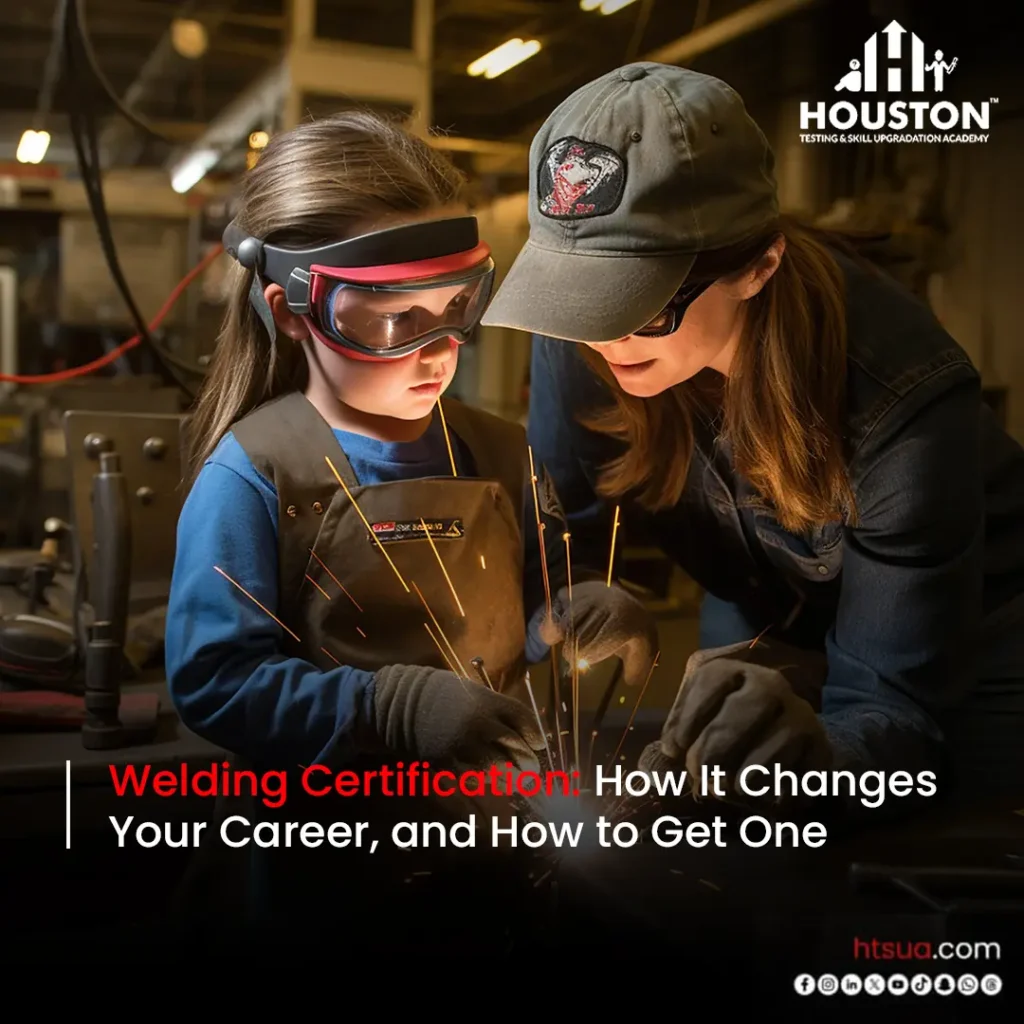
You can lay a clean bead, read a blueprint without help, and handle positions most welders avoid. None of that shows up on a job application the way a certification number does. A hiring manager scanning fifty applications in an afternoon isn’t going to call your last three supervisors to confirm it either.
Employers hiring for fabrication, energy, construction, and manufacturing roles have one shortcut they trust more than a résumé: proof that a recognised body has already tested your welds and signed off on them. That’s what welding certification for beginners, and for welders already years into the trade, actually solves. It turns hands-on skill into something an employer can verify in the time it takes to look up a number.
In this blog, let’s look at how welding certification helps your career, which certifications actually matter, and what becoming a certified welder involves in practice.
Your skill deserves a credential that proves it. Start with HTSUA.
A] Why Certification Has Become the Real Filter in Hiring
A strong weld looks the same whether or not the welder behind it is certified. The problem is, an employer looking at a job application has no way to know that without proof, and most won’t take the risk of assuming.
This is the importance of welding certification in industry today. It replaces a subjective judgement call with a documented, third-party-verified result. The American Welding Society confirms that certification requires passing a performance-based test tied to a specific process, material, and position, not a general claim of experience.
For hiring managers moving fast, that distinction decides who gets shortlisted. Two candidates can have nearly identical site experience, and one of them will still get the call back first, simply because their claim comes with a number that an employer can check.
B] How Welding Certification Helps Your Career
Getting certified opens up more than a line on a résumé. It compounds in a few specific ways.
Structured hiring processes at larger contractors and industrial employers often screen out uncertified applicants before a human even looks at the file, so certification gets a candidate past the hardest filter first. Beyond that first hurdle, certified welders are frequently paid more for the same base skill set, not because they weld any differently, but because employers are paying to remove risk rather than just buy technique. That wage gap tends to widen further on specialised processes where fewer welders hold the credential.
The bigger shift shows up later. A base-level credential like AWS Certified Welder is often the entry point into higher-paying verticals: welding inspection, welding education, pipeline and structural steel work, and supervisory roles. Most of these stay out of reach for uncertified welders, no matter how strong their technique looks on the shop floor, and that’s the real career opportunity certification unlocks, not the first job, but the ones after it.
C] How to Become a Certified Welder
Broken into stages, the path looks more approachable than it sounds. For most candidates, it comes down to preparation, testing, and maintenance, not years of formal schooling.
Start by confirming which certnification actually matches the work you want. The Certified Welder credential is purely performance-based, with no coursework and no prerequisites, which makes it the natural starting point for beginners. From there, book a session at an accredited testing facility and complete a qualification test on the process and position relevant to your target role.
Structural steel, pipeline, sheet metal, and refinery piping are the common categories candidates choose. A CW test itself typically runs somewhere between two and four hours, depending on the process. Once the weld passes inspection, the facility handles the paperwork, and the certification usually lands within a few weeks.
Here’s the part most candidates miss: Certification generally needs to stay active through continued, documented use of the qualified process. A gap in employment, or a missed renewal window, can leave a credential technically valid but functionally inactive. Treat maintenance as part of the certification, not an afterthought, and it stays useful years down the line.
D] Best Welding Certifications for Jobs and Career Growth
Not every certification carries equal weight. Choosing the right one comes down to where you actually want your career to go.
Certified Welder is the foundational credential most beginners start with, built entirely around performance rather than classroom hours. The Certified Welding Inspector sits a step up, aimed at welders moving into quality assurance, and it generally requires a mix of documented experience and formal education alongside the test itself. A Certified Welding Educator suits welders who want to train the next generation, and it usually builds on an existing CWI. The Certified Welding Supervisor targets welders ready to lead a team rather than just execute the work themselves.
Among the top welding certifications for professionals already established in the trade, CWI and CWS tend to open the most supervisory and higher-paying roles. They signal something beyond individual technique: responsibility for other people’s work, not just your own.
If you’re weighing overseas options specifically, our trade test preparation guide for overseas recruitment covers much of the same ground for candidates applying internationally.
E] How Houston Gets You Certification-Ready the Right Way
At Houston Testing and Skill Upgradation Academy, we treat certification the way employers do as proof, not as paperwork. Our welding preparation is built around the actual performance standards used in AWS testing, alongside Gulf-recognised frameworks like Takamol and NSDC. This ensures that all candidates walk into an accredited test already familiar with the process, the equipment, and the pace of a real assessment.
A trade test rewards preparation as much as raw ability, and this is exactly where structured skill development courses in Mumbai make a measurable difference. Candidates work through sessions covering the exact positions and processes their target certification requires, refreshing technique under a timed clock, reviewing safety protocol as its own graded component rather than an assumption, and getting hands-on with equipment they’ll actually see on test day.
Our trainers work with welders at every stage. Some are preparing for their first Certified Welder assessment. Others are already years into the trade and working toward CWI, CWE, or CWS. Either way, candidates who prepare specifically tend to pass closer to their real capability, instead of losing marks to a test format they’ve never actually practised under pressure.
Turn your welding experience into career opportunities that pay for it
Conclusion: Your Weld Is Only as Valuable as the Proof Behind It
Demand for certified welders keeps climbing across infrastructure, energy, and manufacturing. Employers are increasingly unwilling to gamble on an uncertified hire when a certified one is sitting right next to them in the applicant pool, often for a similar wage.
Your welds have carried your reputation for years. It’s time your certification did the same. Get in touch with our team of expert trainers to find the right certification path for where your career goes next.
Categories
Latest Post

July 9, 2026