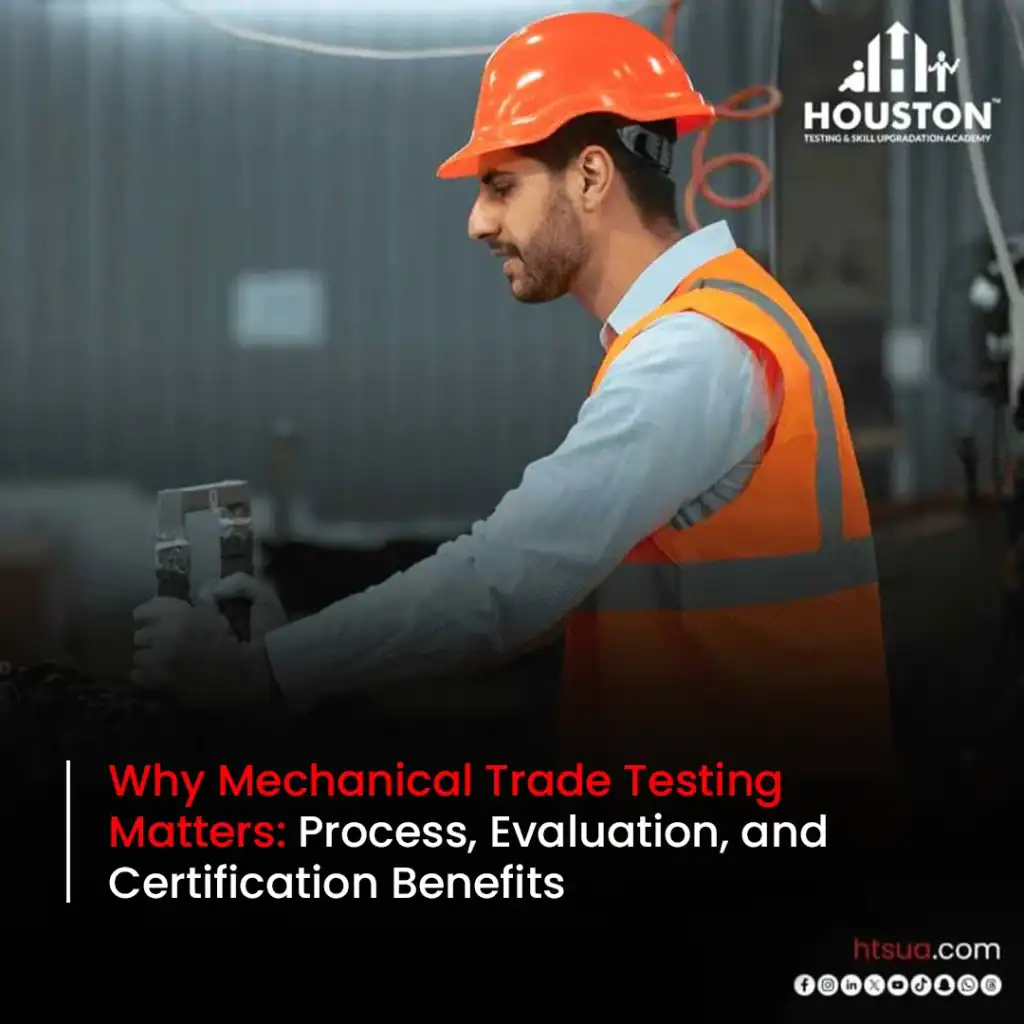
Why Mechanical Trade Testing Matters: Process, Evaluation, and Certification Benefits
If you’re hiring mechanical workers for construction, manufacturing, oil and gas, or large infrastructure projects, you’ve probably faced this familiar dilemma. A technician looks experienced on paper. Interviews suggest confidence. The project timeline is tight, so you move quickly.
Then, once the project begins, equipment handling errors appear. Maintenance cycles slow down. Safety deviations increase. Productivity targets start slipping.
Across construction and heavy engineering sectors, international and large-scale mechanical hiring has become unavoidable. Skill shortages are real. Project complexity is rising. Safety and compliance expectations are stricter than ever. Yet margins are thinner.
This is why more employers are shifting away from assumption-based recruitment toward structured skill verification. At the centre of this shift is mechanical trade testing and certification.
From our experience at Houston Testing Upgradation Academy, one truth stands firm: the cost of hiring wrong mechanically is always higher than the cost of testing right.
Verify Skills Before Deployment with Recognised Certification
A] Strategic Importance of Mechanical Trade Testing
Before diving into processes and certifications, it’s important to understand what is mechanical trade testing and why it matters so deeply in today’s projects.
Mechanical trade testing is a structured evaluation of a worker’s practical skills, technical knowledge, and decision-making ability related to mechanical trades. It verifies whether a candidate can safely and effectively perform tasks such as equipment installation, alignment, maintenance, diagnostics, and troubleshooting.
In mechanical-intensive industries, performance errors don’t just reduce productivity. They create safety risks, equipment damage, downtime, and regulatory exposure.
This is why employers are no longer asking whether to test. They’re asking how do mechanical trade tests work and how to integrate them into hiring strategy.
B] What Goes Wrong Without Mechanical Skill Verification
1. Where Most Mechanical Hiring Failures Begin
Most failures don’t start with dishonesty. They start with assumptions:
- Assuming years of experience equal technical competence.
- Assuming certificates reflect real hands-on ability.
- Assuming interviews predict on-site performance.
2. The Cost of Skills Mismatch in Mechanical Roles
In mechanical environments, a skills mismatch becomes visible very quickly. Improper torque application damages machinery. Incorrect alignment causes vibration and breakdowns. Poor diagnostics lead to repeated downtime.
This is exactly why mechanical trade testing for construction workers has become essential. Without structured testing, employers only identify weaknesses after equipment is already operational.
3. What Happens Without Structured Assessment
Without mechanical trade testing, organisations commonly face:
- Frequent rework and maintenance failures.
- Higher accident and near-miss rates.
- Extended commissioning timelines.
- Loss of client confidence.
These problems don’t appear in recruitment dashboards. They appear as project delays, warranty claims, and safety incidents.
C] Step-by-Step Mechanical Trade Testing Process
Understanding the step-by-step mechanical trade testing process helps employers see how testing creates predictability before deployment.
Step 1: Role-Specific Skill Mapping
The process begins by defining the exact competencies required. A fitter, millwright, HVAC technician, or maintenance engineer requires different benchmarks.
Step 2: Theoretical Knowledge Assessment
Candidates are evaluated on technical fundamentals, safety principles, equipment understanding, and fault analysis.
Step 3: Practical Trade Simulation
This is the core of the process. Candidates perform real mechanical tasks under observation, such as assembly, alignment, calibration, maintenance, and troubleshooting.
Step 4: Safety and Compliance Evaluation
Safe work practices, tool handling, understanding of lockout/tagout, and hazard awareness are assessed.
Step 5: Documentation and Certification
Results are recorded, verified, and issued as auditable proof, often in the form of a recognised trade test certificate.
This structured flow is the foundation of every step-by-step mechanical trade test guide used by professional institutes like Houston Testing Upgradation Academy.
D] How Mechanical Trade Tests Are Evaluated
A credible evaluation framework measures three dimensions:
1. Technical Accuracy
Precision in measurement, assembly, alignment, and installation is assessed against industry tolerances.
2. Process Discipline
Candidates are evaluated on procedure adherence, sequencing, tool selection, and documentation.
3. Safety Behaviour
Safe equipment handling, hazard recognition, and compliance with safety protocols are closely observed.
This structured scoring ensures objectivity. It eliminates guesswork and ensures that only truly competent workers are certified.
This is also how mechanical trade tests work in professional assessment environments: performance is measured, not assumed.
E] Benefits of Mechanical Trade Certification
Employers increasingly recognise the long-term value of certification-backed hiring. The benefits of mechanical trade certification extend far beyond recruitment.
1. Improved Productivity and Faster Deployment
Certified workers reach productivity benchmarks faster. They require less corrective supervision and adapt more quickly to site procedures.
2. Reduced Safety and Equipment Risk
Competency-based selection lowers accident rates, equipment damage, and warranty claims. Workers understand not just how to perform tasks, but how to perform them safely.
3. Higher Client and Regulatory Confidence
Certification provides auditable proof of workforce competence. This strengthens compliance, inspection readiness, and client trust.
4. Scalability Across Large Projects
Standardised testing allows consistent quality across regions and workforce batches. This is essential for multinational contractors.
These are the core benefits of mechanical trade certification that make it a strategic asset, not just a hiring tool.
F] Mechanical Trade Testing in Construction and Heavy Industry
Mechanical systems form the backbone of modern construction and industrial projects. From cranes and compressors to HVAC, piping, and rotating equipment, performance depends entirely on workforce competence.
This is why mechanical trade testing for construction workers has become standard practice in high-risk, high-value projects.
Testing ensures that:
- Installations meet design tolerances.
- Commissioning proceeds smoothly.
- Maintenance cycles are predictable.
- Safety compliance is embedded from day one.
For contractors, this reduces project overruns and protects margins. For clients, it protects asset integrity.
G] Choosing the Right Mechanical Trade Test
Employers frequently ask, Which trade test is best for mechanical workers? The answer depends on role complexity, industry requirements, and destination-country regulations. The best test is one that:
- Reflects real site conditions.
- Measures practical performance, not just theory.
- Aligns with international mechanical standards.
- Produces auditable, recognised documentation.
At Houston Testing Upgradation Academy, a reliable provider of skill development courses in Mumbai, assessments are designed to mirror real mechanical environments, ensuring that certifications reflect true job readiness.
H] Why Employers Partner with Houston Testing Upgradation Academy
Not all testing institutes deliver equal value. Experience, infrastructure, and industry alignment make the difference.
At Houston Testing Upgradation Academy, mechanical trade testing is treated as a strategic workforce solution, not an administrative formality.
Employers benefit from:
- Standardised, role-specific assessments.
- International alignment and auditable results.
- Scalable testing for large workforce volumes.
- Reliable certification for deployment and compliance.
This partnership approach strengthens hiring frameworks and reduces long-term operational risk.
Verify Skills Before Deployment with Recognised Certification
Conclusion
Mechanical hiring is not becoming simpler. It’s becoming more exposed. Projects are larger, equipment is more complex, and safety expectations are higher than ever.
In this environment, resumes and interviews are no longer enough. Without verification, employers gamble with productivity, safety, and asset performance.
The best mechanical workforce strategies share one principle: skills must be tested before deployment, not after failures occur.
When mechanical trade testing and certification are integrated into hiring, projects run more smoothly. Equipment lasts longer. Safety improves. Leadership focuses on delivery instead of recovery.
That’s why employers should no longer view Houston Testing Upgradation Academy as merely a testing provider, but as a strategic partner in building reliable, high-performing mechanical teams. Contact us today!
Categories
Latest Post